
POSH Training for Development Support Centre, Gujarat
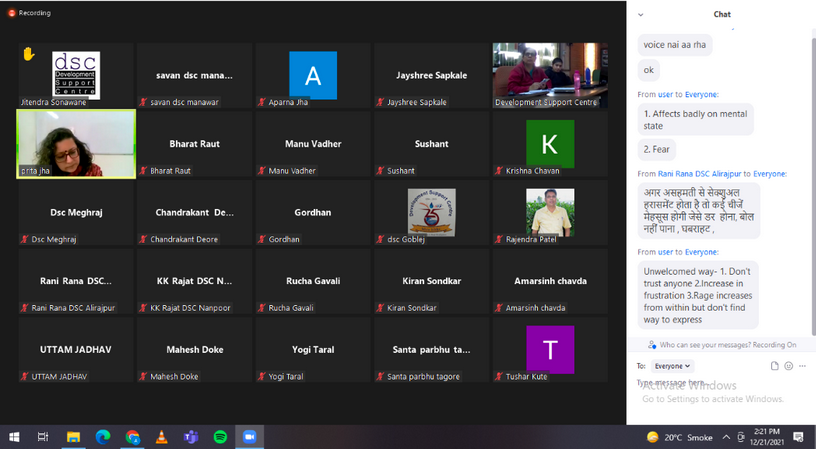
POSH Training for Development Support Centre, Gujarat Prita Jha conducted a training on POSH (Prevention of Sexual Harassment at Workplace Act, 2013) for Development Support Centre, Gujarat. The Development Support Center (DSC) is a resource organization that provides knowledge-based support to Non-Government Organizations (NGOs), Government agencies and other stakeholders in the field of Participatory Natural Resource Management (PNRM) and Sustainable livelihoods. The training was attended by DSC staff from multiple states like Maharashtra, Rajasthan, Gujarat, and Madhya Pradesh. The total number of attendees was 80.
Training of Support Persons
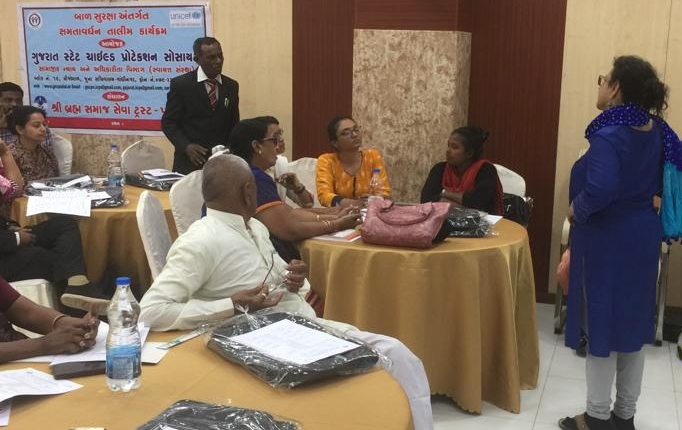
Training of Support Persons Peace and Equality Cell President, Prita Jha was speaker at an Induction Training for Support Persons identified under POCSO Act 2012 conducted by Gujarat State Child Protection Society in collaboration with UNICEF. We started the day with understanding context of child sexual abuse in India and it’s prevention with reference to POCSO act. Prita started by talking about the research by WCD in 2007 which revealed disturbing statistics of child sexual abuse in India. She explained what child sexual abuse is, it’s prevalence, impact, why are children vulnerable and how do the perpetrators approach their survivors. In the second session, we did an overview of the POCSO Act, 2012 and discussed roles of different bodies involved- The District Child Protection Unit, Police and CWC. POCSO ACT We discussed the POCSO act, with special attention to 3 topics: How the law attempts to deal with the vulnerability and innocence of children. Revictimization and secondary victimization by the Criminal Justice System- how does the law seek to address these issues. Survivors’ rights and needs POCSO act defines a child a child as any person below the age of 18 years and provides protection to all children under the age of 18 years from the offences of sexual assault, sexual harassment and pornography. The POCSO act is gender neutral. As per thePOCSO ACT, “Expert” means a person trained in mental health, medicine, child development or other related discipline, who may be required to facilitate communication with a child whose ability to communicate has been affected by trauma, disability or any other vulnerability. We discussed a case where the survivor has not been able to give her statement in court because the medical report says that her IQ is borderline normal and hence her statement would not be reliable. POLICE AND POCSO Prita emphasized that POCSO mandates some child friendly procedures to be followed by the Police. For example, statements of the survivor to be recorded at his/her residence or place where they usually stay as far as possible by a woman officer not below the rank of sub-inspector. The police should not be in uniform when recording statement of the survivor and the statement should be recorded survivor’s residence. Police shall protect the identity of the child from public media unless otherwise directed by the Special Court. A participant said that the Police often end up leaking the information to the media. At times, they might not mention the name of the survivor but mention other essential details such as the address and school of the survivor, which makes it very easy to identify the survivor. Prita ma’am discussed a case where a survivor’s mother expressed her concern at the Police Station about the identity of the survivor being revealed by the media. The Police officers told her that they really cannot control it at times and the information will be leaked. The police officer making investigation, shall, while examining the child, ensure that at no point of time the child comes in contact with the accused. But a support person spoke up that there have been various instances where the accused and the survivor were taken to the Police Station in the same vehicle. The statement should be recorded as spoken by the child and the words of the child should not be changed in any way. Prita discussed a case where the Police and the medical report said that the girl was deaf and dumb. But the mother said that the girl can talk and Police’s poor quality of work made the case more complicated and it went on for five more years. POCSO act Section 26(3) and Section 38(2) provides for the assistance of a special educator to the Special Court, Magistrate or Police Officer, as the case may be for recording the statement and evidence of the child having a mental or physical disability. POCSO RULE 4(2)(E) states that where an SJPU(Special Juvenile Police Unit)or the local police receives any information under sub section (1) of Section 19 of the Act, they must inform the child and his/her parent or guardian or other person in whom the child has trust and confidence of the availability of support services including counselling, and assist them in contacting the persons who are responsible for providing these services and relief. The case including the need of the child for care & protection and steps taken in this regard should be reported by the Police to the Child Welfare Committee (CWC) and the Special Court within 24 hours. [Section 19(6)] CHILD WELFARE COMMITTEE ( CWC ) The CWC, thereafter, should determine within three days whether the child needs to be taken out of the physical custody of his/her family or shared household and placed in a shelter home. The CWC should take into account the opinion of the Child. CWC should conduct an enquiry. COMPENSATION A very unusual thing was that none of the support persons and CWC members present knew that the authority responsible for overlooking compensation in child sexual abuse cases is The District Legal Services Authority (DLSA). One participant said that the authority responsible for compensation is the Women and Child Department (WCD). They were also not aware of the notification by Gujarat Government in 2016 regarding the Gujarat State Survivor Compensation Scheme. In the third session, we continued discussing role of Police and Police Stations, role of Support Persons and Counselling tips.
A series of Legal Training Webinars on Child sexual abuse & POCSO with all District Legal Services Authority
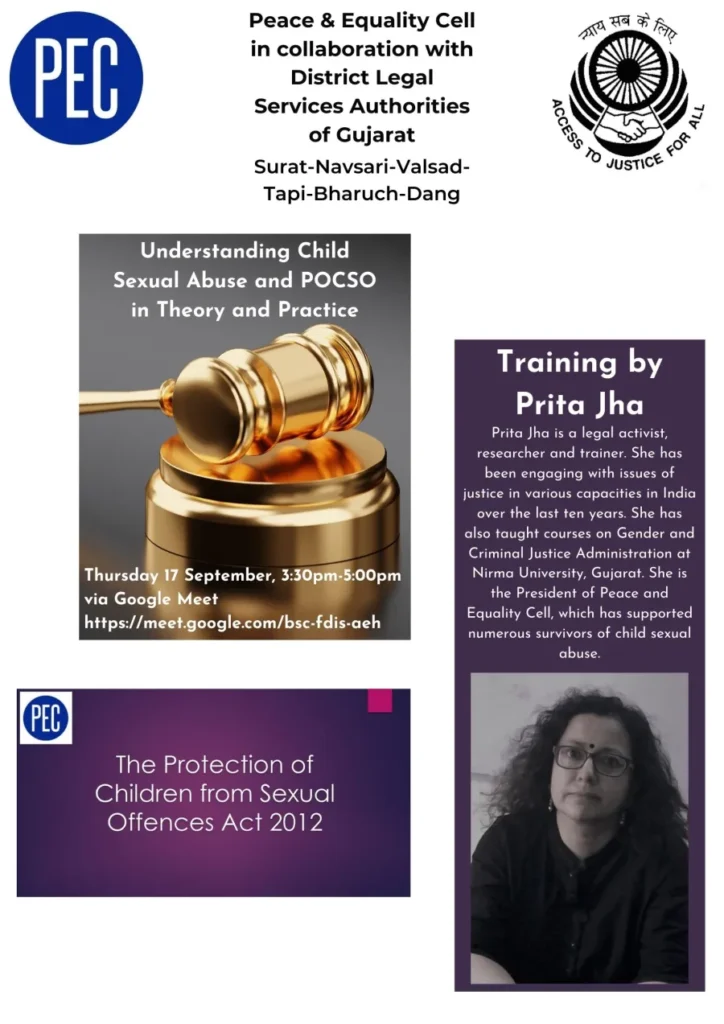
A series of Legal Training Webinars on Child sexual abuse & POCSO with all District Legal Services Authority PEC and the Legal District Services Authority recently collaborated to undertake a pioneering rollout of legal training on the POCSO law as well as Child Sexual Abuse to all 33 districts within Gujarat starting with Surat, Vadodara, Ahmedabad, Mehsana, Rajkot and Bhavnagar. PEC has now completed this programme and can already see the benefits of sharing legal knowledge in order to support key social work in this area. It has been very uplifting to have maximum participation of Para Legal Volunteers, Advocates and other stakeholders in these webinars. In the first of our series, we welcomed and were honoured to have Member Secretary, Shri. H. S. Mulia from Gujarat State Legal Services Authority, who pioneered this programme join the call of 60 participants. The agenda for the call set was to discuss: Child Sexual Abuse – awareness of child sexual abuse and the need for it, explaining the process of grooming, explaining what is safe touch and unsafe touch by showing a child friendly video called ‘Komal’ to all the children, parents and teachers, discussing what can we do to prevent the child sexual abuse, impact of child sexual abuse and what can we do if it happens POCSO Act of 2012 – Background & History, Categories, Roles of Police, Child welfare committee, support person etc, challenges of POCSO, theory and practice Legal framework and Victim Support Q & A related to webinar with Prita We offer online specialised legal training for organisations; from basic to in-depth knowledge-sharing. Please do get in touch to discuss further:Prita Jha: Pritarjha@gmail.com / peaceandequalitycell@gmail.com
Strengthening Communities Through Legal Awareness and Training
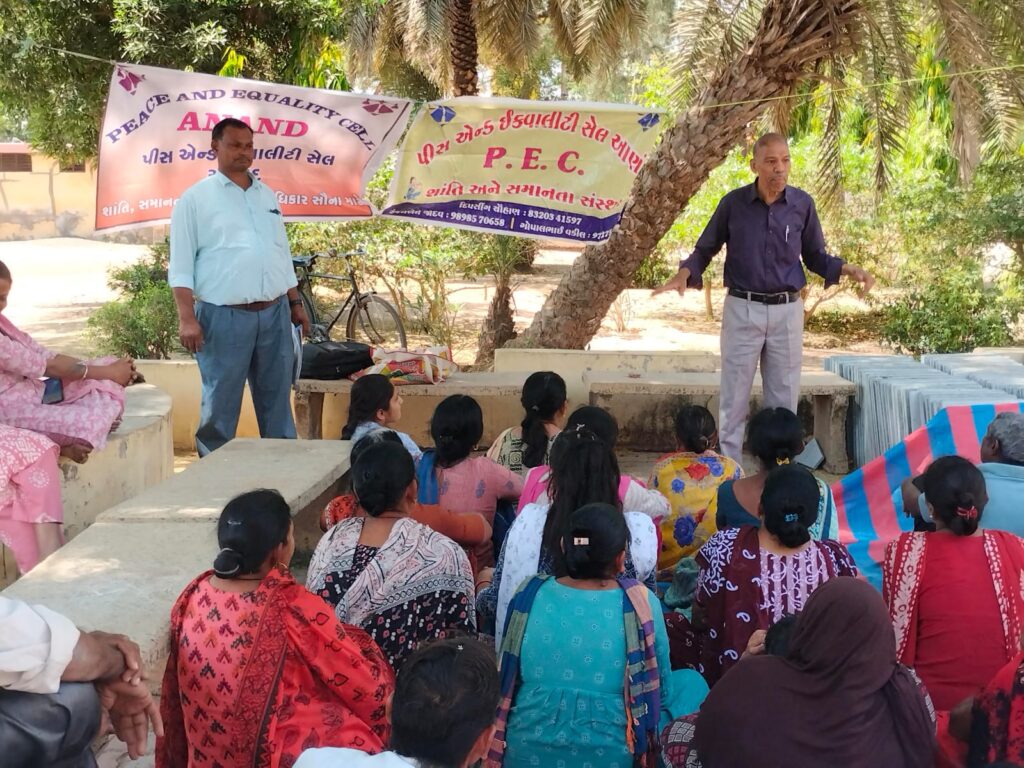
Strengthening Communities Through Legal Awareness and Training Justice cannot be delivered only in courtrooms. It must begin in communities. Many survivors of violence do not seek help simply because they do not know their rights or fear the process. Legal language feels intimidating. Systems feel distant. This is where community-level awareness becomes essential. Peace and Equality Cell conducts regional trainings across Gujarat, engaging community members, parents, educators, and grassroots workers. These sessions focus on understanding laws related to child protection and gender-based violence, identifying early warning signs, and knowing where and how to seek help. When communities are informed, they become the first line of protection. Neighbours intervene. Schools respond. Families seek support earlier. Silence gives way to action. Building safer societies requires collective responsibility and it begins with awareness.
Children’s Day – Listening to Children, Not Just Celebrating Them
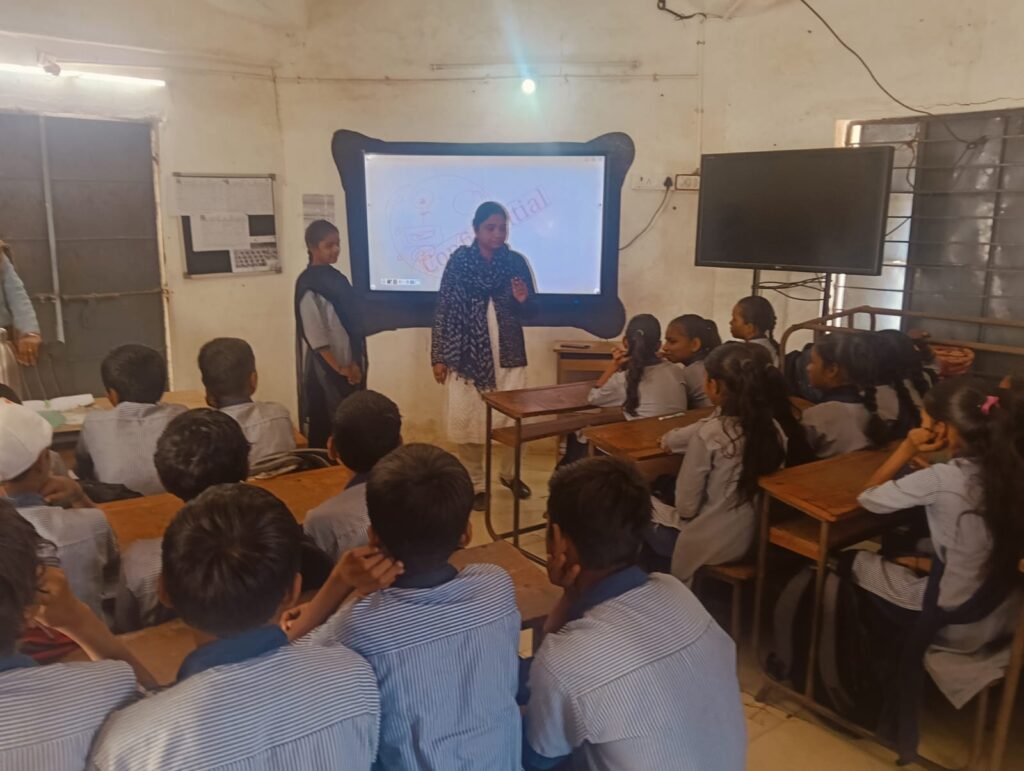
Children’s Day – Listening to Children, Not Just Celebrating Them Children’s Day is often marked by celebrations, performances, and smiling photographs. While joy is important, it is equally important to pause and ask: are we truly listening to children? For many children, especially those facing abuse, neglect, or discrimination, the world does not feel safe. Their voices are often ignored, dismissed, or misunderstood. At Peace and Equality Cell, we believe that children are not just beneficiaries of protection, they are rights-holders. Our work with children focuses on helping them understand personal boundaries, safe and unsafe touch, and their right to speak up. We create spaces where children can ask questions without fear and learn that seeking help is not a mistake. Celebrating children must go beyond one day. It must translate into everyday actions — safer schools, responsive systems, informed parents, and communities that protect rather than silence. True celebration begins when children are heard, believed, and protected.
Engaging Police Cadets on Child Rights – Building a Sensitive Justice System
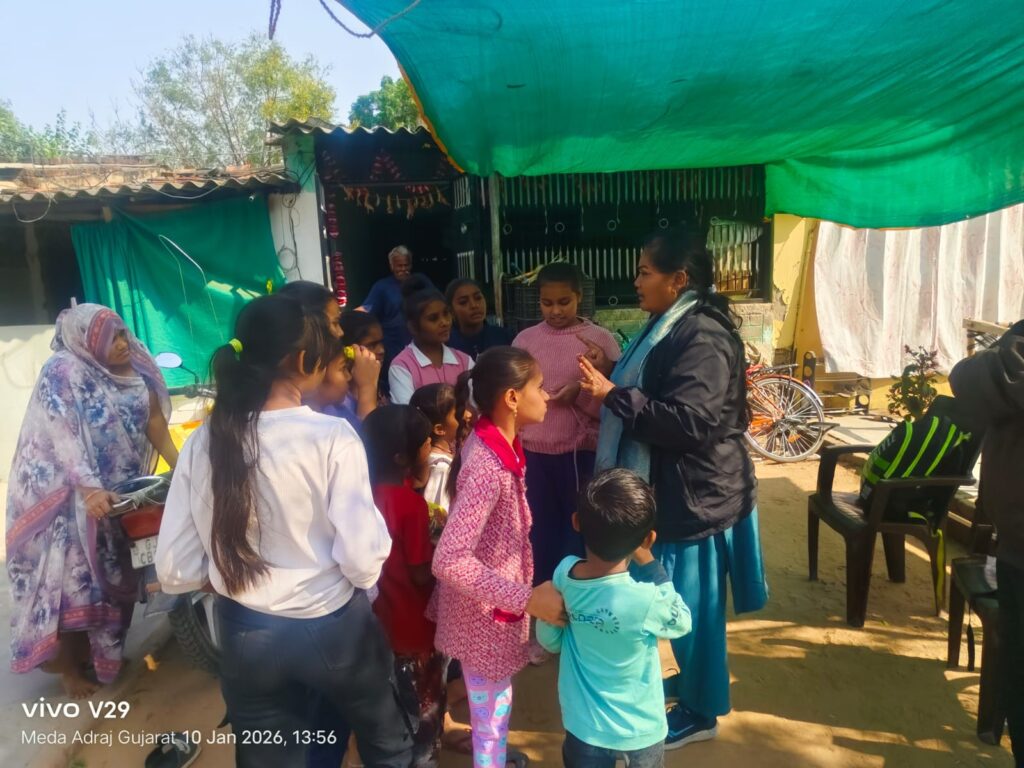
Engaging Police Cadets on Child Rights – Building a Sensitive Justice System Law enforcement plays a critical role in how survivors experience justice. The first response can determine whether a survivor feels supported or silenced. Recognising this, Peace and Equality Cell has actively engaged with police cadets and frontline officers to build awareness around child rights, child sexual abuse laws, and survivor-centred approaches. These sessions focus not only on legal provisions but also on empathy, communication, and trauma-informed responses. When police officers understand the psychological impact of abuse, the importance of confidentiality, and the need for child-friendly procedures, the system becomes more humane and effective. Training young cadets is especially impactful – it helps shape a future generation of officers who view protection, not punishment, as their primary responsibility. Strengthening the justice system is not only about laws on paper. It is about people in positions of power choosing compassion, accountability, and fairness every day.
Re-thinking Law Through the Lens of Neuroscience and Adolescent Development

Re-thinking Law Through the Lens of Neuroscience and Adolescent Development Laws are meant to protect but to do so effectively, they must evolve with knowledge and evidence. One such area that demands careful re-examination is how the legal system understands adolescent behaviour, consent, and sexuality. Recent research in neuroscience shows that adolescent brains are still developing, particularly in areas related to impulse control, judgment, and risk assessment. Yet, legal frameworks often treat adolescents as fully mature decision-makers, without accounting for these developmental realities. This gap can lead to outcomes that are punitive rather than protective. At Peace and Equality Cell, we believe that justice must be informed by science, empathy, and child-centric thinking. Our research and advocacy explore how laws, especially those dealing with sexual offences involving adolescents, can be applied with greater sensitivity without diluting protection against abuse. This does not mean weakening laws. It means applying them with context, understanding, and proportionality, ensuring that children and adolescents are protected, not criminalised unnecessarily. Re-thinking law is not about changing its intent, it is about strengthening its impact.
Breaking the Silence Around Child Sexual Abuse and Domestic Violence
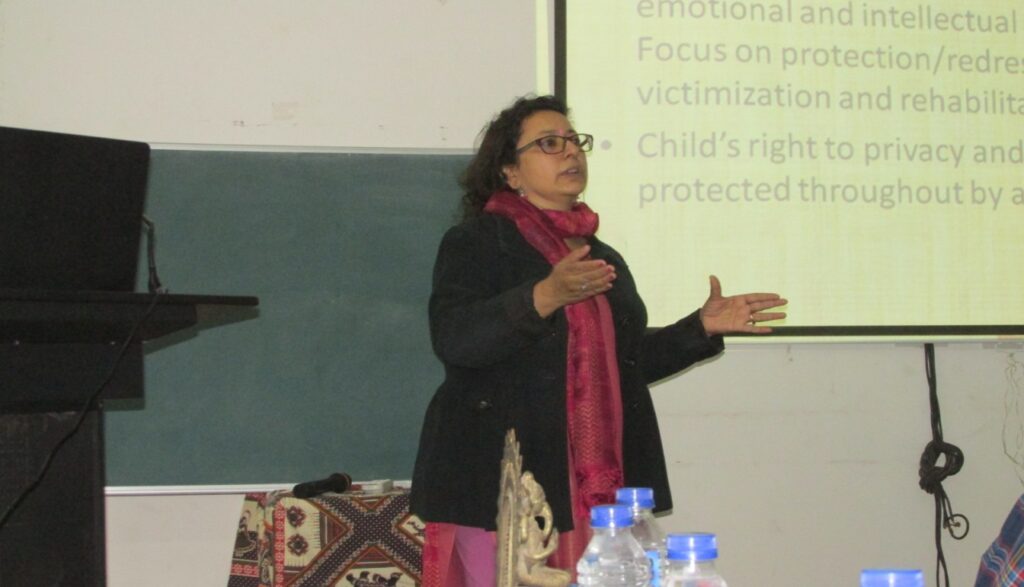
Breaking the Silence Around Child Sexual Abuse and Domestic Violence Silence is one of the greatest allies of violence. Whether it is child sexual abuse or domestic violence, harm often continues not because laws do not exist, but because conversations do not. In many families and communities, abuse is hidden behind ideas of “honour,” “shame,” or “private matters.” Children are told to stay quiet. Women are asked to adjust. Survivors are blamed, questioned, or discouraged from seeking help. This culture of silence allows perpetrators to act repeatedly and without fear. At Peace and Equality Cell, we believe that speaking out is the first step towards justice. Awareness is not just about knowing the law — it is about recognising abuse, trusting survivors, and creating safe spaces where people feel heard and supported. Through our community trainings, school sessions, and legal awareness programs, we work to dismantle myths around abuse and encourage reporting without fear. Breaking silence also means strengthening systems – police, legal institutions, shelters, and community networks, so that when survivors speak, they are met with dignity, sensitivity, and action. Ending violence begins when silence ends. Every conversation matters. Every voice matters.